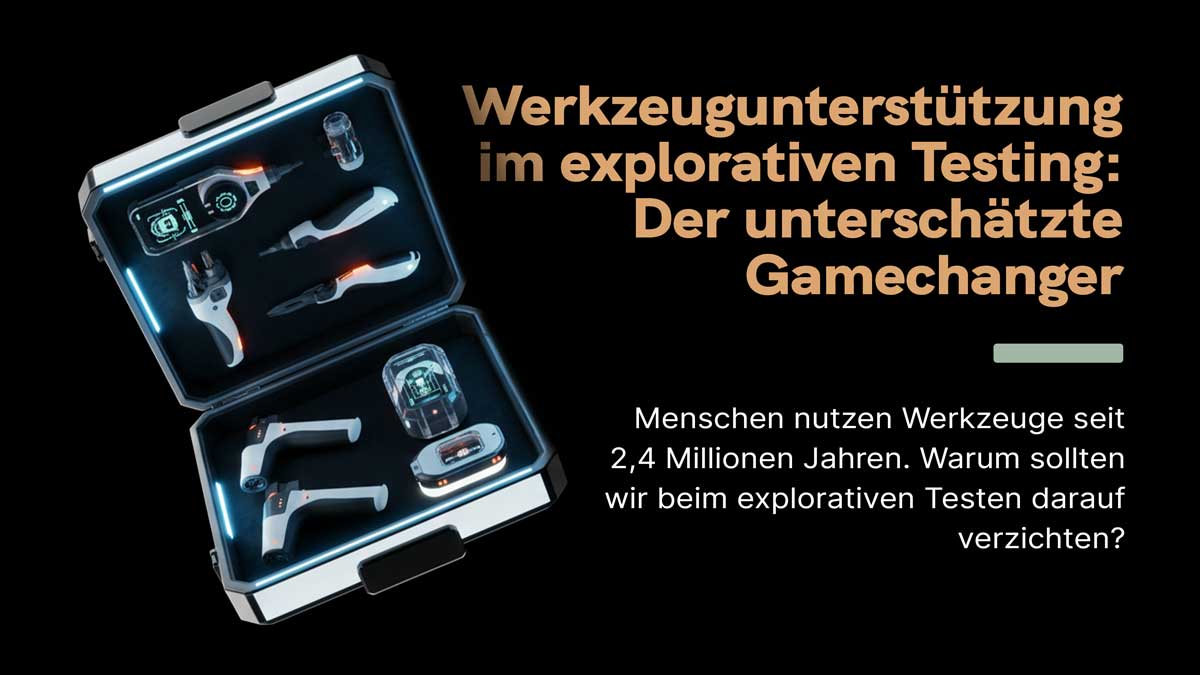
Exploratory testing is no longer the wild clicking around that people used to imagine. We are hopefully all past that point. At the latest since courses like BBST® and books by Elisabeth Hendrickson, Lisa Crispin and Janet Gregory professionalised the term and established concepts like test charters, tester roles and test missions, it has been clear: exploratory testing is anything but unplanned. It is a demanding approach that requires structure, skill and focus.
What we still notice, however: when it comes to tools in the exploratory context, there is a clear gap — one that is still not taken seriously in many teams. While we have long since stopped working without tools like Tosca, Playwright and others for our automated tests, the toolbox for supporting human-led testing often remains surprisingly empty. At best, we use tools like JIRA to somehow record our test results — and that is about it. Yet there is so much more to be gained.
Even though exploratory testing is primarily driven by human intuition, curiosity and experience, that does not mean we cannot get support along the way — quite the contrary. There is already a movement that demands exactly this: understanding tools not as constraints, but as enablers. Maaret Pyhäjärvi puts it beautifully in her book "Contemporary Exploratory Testing": "Test automation belongs in exploratory testing. You can't explore with great coverage without automation. You can't automate without exploring in a relevant way."
What does this mean in concrete terms?
First: automation can directly help us in exploratory testing. If we already have a certain baseline coverage through automated tests, we can focus exploratory sessions on new questions, unusual paths, and buggy behaviours — rather than clicking through endless login screens.
Second: exploratory testing is the natural precursor to automation. Even if "automate everything" sounds catchy as a slogan, it is neither feasible nor desirable from a testing perspective. We need an answer to the question "what should we actually automate meaningfully?" — and exploratory testing can provide one.
During the exploratory session itself, tools can also be enormously helpful. Two examples we find really compelling:
- Bug Magnet: A simple but brilliant browser plugin that feeds us structured input values — the kind we stop thinking about in everyday work but which, from experience, tend to break things: SQL injections, XSS attempts, long text strings, special characters. Instead of typing these every time, a right-click gives us a selection ready to go. Saves time, increases test depth, lowers the barrier.
- Exploratory Testing: The name is somewhat on the nose — it is a lightweight but extremely practical tool. It lets you easily take notes during a test session, capture screenshots, and document bugs immediately — all without separate tools or context switches. Nice feature: metadata such as URL, browser version, or timestamp is logged automatically. Ideal for anyone who wants to accompany their exploration directly in the browser and make it structured and traceable.
And honestly: if we are already trying to focus more sharply through test charters, structure our time with clear missions, and direct sessions towards specific questions — why would we stop exactly there when it comes to tool support?
The argument that tools constrain creative freedom only holds up to a point. Good tools bring no dogma; they adapt to typical exploration patterns. They help capture things without disrupting flow. And ultimately: they get the most out of our experience and skills, because they relieve us and create space for what matters — genuine understanding.
We are convinced: the role of tools, especially in exploratory testing, is still underrated today. Yet there is nothing wrong with letting a tool help you in a manual activity. On the contrary — the more complex our systems, the more we need this support to avoid remaining at the obvious.
So: next time you go into an exploratory test session — take not only your head and your instincts, but also a couple of small helpers. You will be surprised how much further they get you.
Exploration is not an end in itself. It is about discovering things that would otherwise slip through the cracks — structured, targeted, and supported by clever tools. Time to acknowledge that. And spoiler at the end: we are also working on a tool — stay tuned!