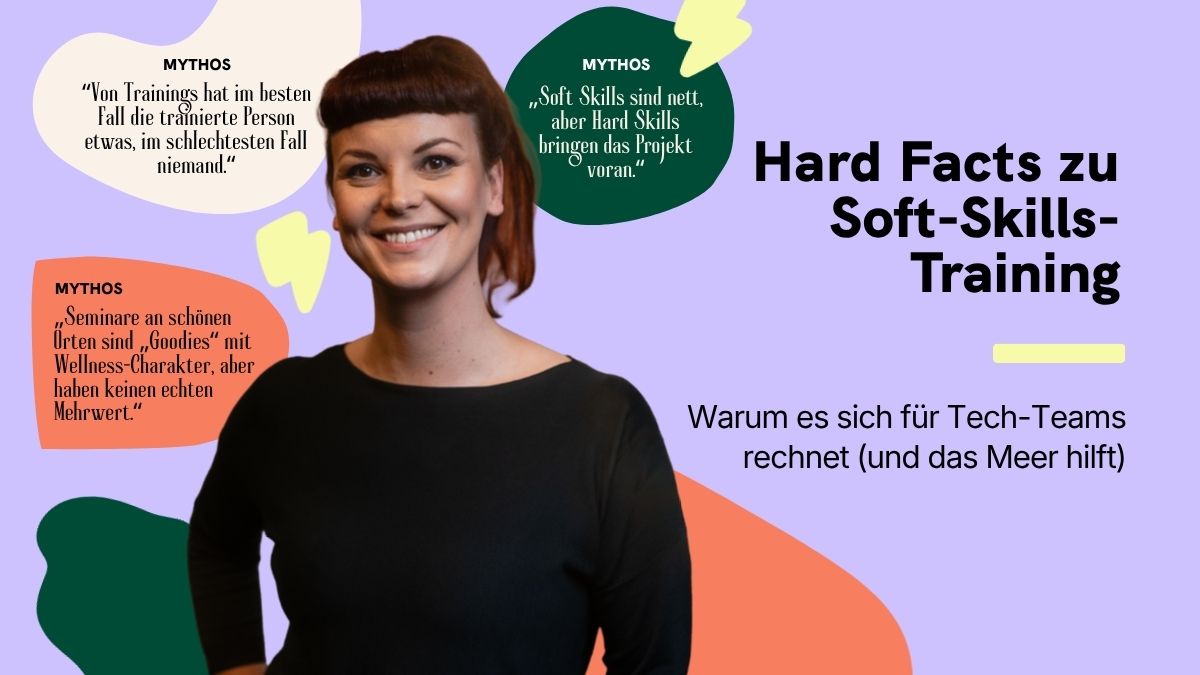
why it pays off for tech teams (and the sea helps)
"At best, only the person who was trained benefits from training — at worst, nobody does." "Soft skills are nice, but hard skills move the project forward." "Seminars in nice locations are 'perks' with a wellness feel but no real added value."
These are myths oose trainers hear repeatedly from technically oriented environments — from developers, architects, and management alike. Yet there is scientific evidence showing the opposite.
The whole team benefits from one person's training — right up to senior management!
Imagine one team member attends a training — and the biggest beneficiary is someone who wasn't even there. It seems obvious that training makes it easier to achieve your own goals. A recent Harvard Business School study (Espinosa & Stanton 2025) shows that trained employees achieve their goals on average 10% more often than their untrained colleagues. Concretely, the study group showed an increase from 71.9% to 78.5% per week — while untrained colleagues remained unchanged. But that is far from all. The study also shows that the true value of training shows up elsewhere: one level higher in the hierarchy. Employees who can work more independently thanks to their trained knowledge and skills demand far less support from their managers on operational matters. Managers then have more time for leadership and strategic tasks — and can improve their own goal achievement by an average of 3%. This can even be quantified: Espinosa and Stanton calculate that 45% of the total benefit of training for an organisation comes from the operational relief of managers — the so-called "spillover effect."
In IT, the spillover effect delivers even more value than elsewhere.
What this means concretely in tech teams becomes clear around the topic of focus. Anyone working in development, whether as a developer or team lead, knows this scenario well: you've been deep in a tricky problem for an hour. Finally the moment arrives when the solution starts to take shape — and then a Slack message pops up: "Quick question, only takes two minutes." Twenty minutes later you're still not back in your flow.
This means: the more experienced seniors, architects, and leads are needed for operational support of colleagues, the more they lose productivity in their actual work. On top of that, context switches caused by ad-hoc requests cost disproportionately more time and energy for cognitively demanding tasks (Meyer et al. 2014). When a senior developer is pulled out of deep work on a task, it takes up to 23 minutes after returning to reach the previous concentration level again (Mark et al. 2008). Every interruption has a cost. In software development, it is particularly high.
Missing soft skills are the real productivity killers in the system.
But that is only one aspect. If we look at the whole system: what costs more — a developer who doesn't know an API, or two developers who haven't spoken to each other for three weeks? In one of my trainings, a tech lead told me he spends half his working time communicating with two developers. Not because they're technically weak — but because an unspoken conflict has been simmering between them for months. Support for technical questions due to team members' missing hard skills is only one of the reasons seniors and managers get pinged regularly. Interpersonal friction from unclear communication, missing feedback, and unresolved tensions due to poor conflict resolution skills hits even harder. Or, looking at it from the other side, the benefit of trained soft skills is immense: a 2023 study showed that training purely soft skills (communication, problem-solving, teamwork) in a manufacturing environment increased the productivity of trained employees by 12% (Adhvaryu et al. 2023). According to the study authors, the return on investment was more than 250% through significantly increased team autonomy and lower employee turnover. If the effects of soft skills are already this measurably clear in a standardised production environment, the lever in software development is many times greater. When it does not succeed in bringing different perspectives on an abstract matter to a shared understanding and resolving tensions at eye level, technical questions quickly become emotional conflicts. For developers this means pure frustration; for managers it means highly paid key people are blocked. In the end, these friction losses produce expensive mistakes and technical debt.
The numbers and the lever are undeniable. But how do we train this knowledge so it can actually be called upon in the stressful tech day-to-day? The answer lies not only in the what, but also in the where.
Learning by the sea works. And sustainably so.
For the positive effects of training to make themselves felt, it is not enough to have "heard something once." It takes the step from knowledge to capability. With soft skills in particular, this requires a healthy amount of self-reflection and trying things out in a safe environment, in order to shed old patterns and develop one's own attitude. In the daily work routine, that is almost impossible.
How difficult it is to run in the hamster wheel while simultaneously reflecting on what you're doing — most people know this from their own experience. This is no coincidence; it has a neurobiological explanation. Neuroscience confirms that the familiar context (work routine in the office or remote) also triggers and reinforces familiar, automated behavioural and stress expectations in the brain (Clarke et al. 2022). Conversely, a temporary step away from the familiar environment facilitates the formation of new neural connections — the neurobiological basis for learning.
So what is needed? A place that is far enough from everyday life to take the brain off autopilot, while offering enough calm for new things to actually land. In principle, any genuine change of location to a learning-conducive environment helps — such as on our oose.campus in Hamburg or at oose. im Kloster. A maritime environment works particularly intensively: apart from the fact that learning with a sea view, stimulating conversations in a deck chair, and an evening beach walk are simply enjoyable, there is scientific evidence here too. Looking at water measurably lowers biological stress levels and calms the nervous system (Völker & Kistemann 2011). This relieves exactly those brain areas we need for empathy and complex communication, and provides the best foundation for genuinely lasting learning success.
Conclusion: whether you lead or develop — sharpening soft skills is the ideal lever for noticeably more productivity in your team and your own tech day-to-day. And oose am Meer offers the ideal learning environment for it.
Fancy learning with sun, sand and sea?
Our soft skills seminars at oose am Meer 2026:
- Communication, Facilitation and Conflict Management Fundamentals (5 days)
- Communication & Facilitation Techniques in IT — with many remote tools (3 days)
- Soft Skills for Architects (ISAQB SOFT) (3 days)
- Conflict Management and Constructive Conflict Resolution (2 days)
- Constructive Conflict Resolution: A Seminar for Product Owners (2 days)
- Agile Leadership (3 days)
- From Stress to Strength: Learning Resilience in Practice (2 days)
Dr. Pia Gebhardt is a trainer and consultant at oose with a focus on communication, conflict resolution, and collaboration in technical teams. As a molecular medicine PhD, she combines scientific grounding with many years of practical experience in innovation, development, and the IT environment. Through her training, she supports professionals and managers in developing soft skills not as an add-on qualification, but as a core competency.
Sources: Espinosa, M. & Stanton, C. T. (2025). "Training, Communications Patterns, and Spillovers Inside Organizations." NBER Working Paper No. 30224, July 2022, Revised June 2025
Meyer, A. N., et al. (2014). "Software Developers' Perceptions of Productivity." Proceedings of the 22nd ACM SIGSOFT International Symposium on Foundations of Software Engineering
Mark, G., Gudith, D., & Klocke, U. (2008). "The Cost of Interrupted Work: More Speed and Stress." Proceedings of the SIGCHI Conference on Human Factors in Computing Systems.
Adhvaryu, A., Kala, N., & Nyshadham, A. (2023). Returns to On-the-Job Soft Skills Training. Journal of Political Economy, Vol. 131, No. 8, pp. 2165–2208.
Clarke, A., Crivelli-Decker, J., & Ranganath, C. (2022). Contextual Expectations Shape Cortical Reinstatement of Sensory Representations. The Journal of Neuroscience.
Völker, S., & Kistemann, T. (2011). "The impact of blue space on human health and well-being." International Journal of Hygiene and Environmental Health.